 Chat With Us

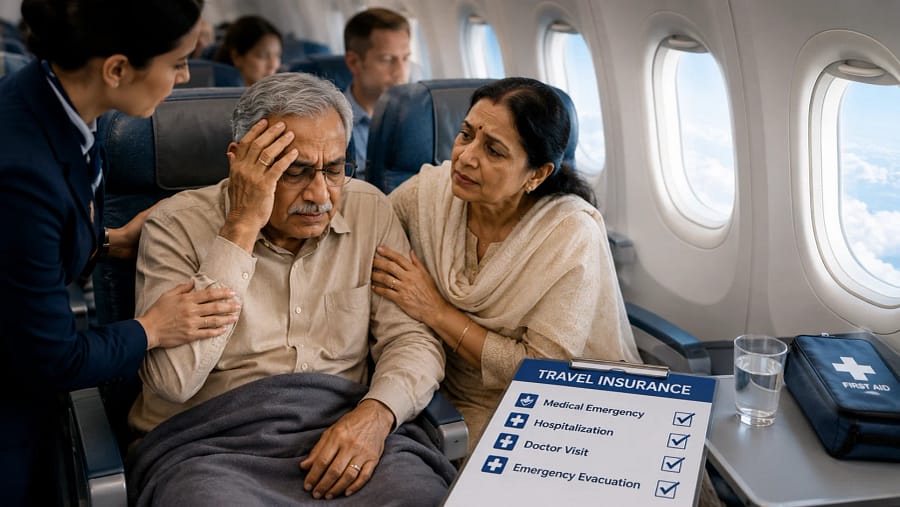
When parents travel from India to the United States, one question worries almost every family:
What happens if my parents become sick during the flight? Will visitor insurance pay for medical expenses?
A flight from India to the U.S. can take 16–24 hours, and elderly travelers may experience dehydration, breathing difficulties, chest pain, dizziness, or other unexpected medical problems.
The answer is not always simple.
Whether visitor insurance covers an illness during the flight depends on:
Here is what every family should know before their parents’ board the flight.
Every visitor insurance policy has an effective date.
Coverage generally starts on the date and time shown on the policy documents, provided all eligibility requirements have been met.
Some plans become effective as soon as the insured departs their home country, while others begin on the scheduled policy effective date or upon arrival in the United States.
Always review your Certificate of Insurance to understand exactly when coverage begins.
| Coverage Aspect | When It Applies |
|---|---|
| Before Policy Effective Date | Not covered |
| In-flight Medical Issues during international travel | Depends on the visitor insurance |
| After coverage becomes effective | Covered according to policy terms |
| Illness Before Policy Start | NOT covered – any illness before the policy start date is excluded |
You can buy insurance before your trip or even after arriving in the United States, but coverage only begins on the effective date of the policy which is as early as the next day. .
If someone becomes ill during an international flight, the airline is responsible for providing immediate assistance.
Cabin crews are trained to handle medical emergencies and have access to:
Depending on the severity of the illness, the aircraft may continue to its destination or divert to the nearest suitable airport.
Medical help is always provided. But let us look at how the insurance works.
Once your parents arrive in the United States, the next steps depend on when the illness began.
If the illness qualifies as a covered medical emergency under the policy, the visitor insurance may help pay for:
Deductibles, policy limits, and exclusions will apply.
Medical expenses incurred before the effective date are generally the traveler’s responsibility.
Your parents are healthy when boarding the flight.
They arrive in New York but the next morning, they develop a high fever.
Likely Outcome: Coverage is generally available because the illness began after the policy became effective.
Your father experiences chest pain halfway through the flight. Emergency medical assistance is provided after landing.
Likely Outcome: Coverage depends on:
Your mother becomes ill two days before leaving India but decides to travel anyway.
The illness worsens after arriving in the U.S.
Likely Outcome: Most visitor insurance plans will not cover treatment for an illness that began before the policy became effective or when in the home country.
Many comprehensive visitor insurance plans include emergency medical evacuation coverage.
This benefit may pay for medically necessary transportation to the nearest appropriate medical facility if the insured experiences a covered emergency.
Some plans also include:
These benefits are subject to the policy’s terms, conditions, and maximum benefit limits.
Before parents begin a long international journey, consider these precautions:
If a traveler has a fever, severe breathing problems, uncontrolled chest pain, or another serious medical condition, consult a physician before flying.
Before purchasing a policy, ask:
Understanding these details before travel can help avoid unexpected expenses later.
Medical emergencies during international flights are uncommon, but they can happen, particularly for older travelers.
The most important step is choosing a visitor insurance plan that matches your parents’ travel dates and health needs.
Rather than assuming every in-flight illness is automatically covered, or automatically excluded, carefully review the policy’s effective date, coverage area, exclusions, and most importantly the certificate wordings for complete details.
Purchasing the right visitor insurance before departure gives families greater peace of mind and ensures that, if a medical emergency occurs after coverage becomes effective, they have financial protection against the high cost of healthcare in the United States.


Studying in the United States can be an exciting experience, but dealing with an.
Explore More
Health insurance eligibility in the United States depends on several factors, including immigration status,.
Explore More
Moving to the United States is an exciting new chapter, but it also comes.
Explore More