 Chat With Us

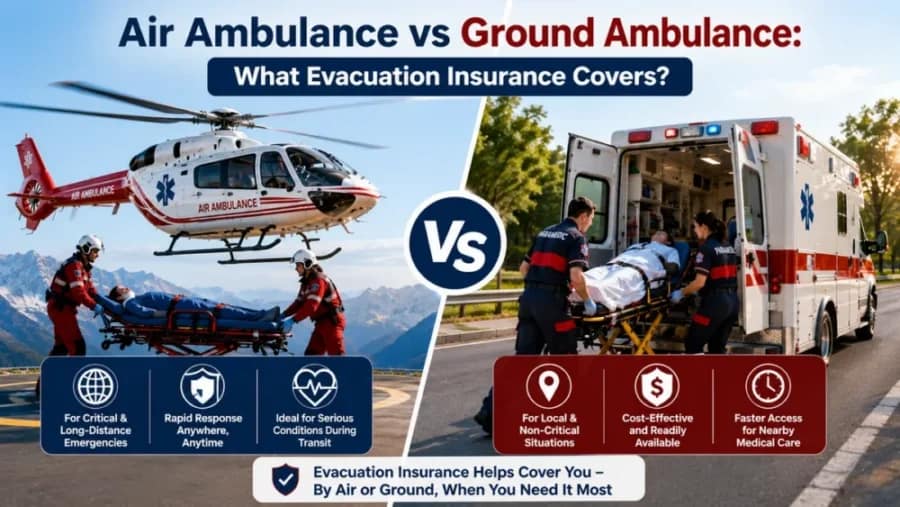
Medical emergencies can happen unexpectedly while traveling. A visitor may experience a serious illness, accident, or injury that requires immediate medical attention. In these situations, getting the patient to the right medical facility as quickly and safely as possible becomes the top priority.
Depending on the medical condition and the traveler’s location, transportation may involve either a ground ambulance or an air ambulance. While many comprehensive visitor insurance plans include emergency medical evacuation benefits, the type of transportation covered depends on medical necessity and the terms of the policy.
Understanding the difference between ground ambulance and air ambulance coverage can help travelers choose the right visitor insurance plan and avoid unexpected medical expenses.
Emergency medical evacuation is a benefit included in many comprehensive visitor insurance plans. It covers medically necessary transportation to the nearest appropriate medical facility capable of providing the treatment a traveler requires.
This benefit is designed for situations where adequate medical care is unavailable at the traveler’s current location or where the patient’s condition requires transportation to a specialized hospital.
For example, if a visitor becomes critically ill while visiting a remote national park and the nearest hospital cannot provide the necessary level of care, the insurance company’s emergency assistance team may arrange transportation to a larger o better equipped medical center.
Coverage is always subject to the policy’s terms, exclusions, benefit limits, and any required approvals.
Ground ambulances are the most common form of emergency medical transportation. These specially equipped vehicles transport patients by road from the location of an emergency to an appropriate medical facility or between hospitals.
Ground ambulance services may include:
Ground ambulance transportation is generally covered when it is medically necessary.
Typical requirements include:
| Coverage Requirement | What it means |
|---|---|
| Medically Necessary | A physician determines ambulance transportation is required. |
| Nearest Appropriate Facility | Transportation is covered only to the closest hospital capable of providing appropriate treatment. |
| Safe Transportation | Traveling by private vehicle could endanger the patient’s health. |
| Covered Medical Condition | Transportation must be related to a covered illness or injury. |
Ground ambulance transportation in the United States can cost several hundred to several thousand dollars, depending on the distance traveled, the level of care provided, and the local ambulance service.
An air ambulance is used when rapid transportation is medically necessary or when ground transportation is not practical or safe.
Air ambulances may be helicopters for shorter distances or specially equipped with fixed-wing aircraft for longer transfers.
Air ambulance services often include:
Air ambulance transportation is significantly more expensive than ground transportation.
Costs can range from $15,000 to well over $100,000, depending on:
Because of the high cost, insurance companies approve air ambulance transportation only when strict medical criteria are met.
Typical requirements include:
| Requirement | Detail |
|---|---|
| Medical Necessity | The patient’s condition requires rapid transportation. |
| Ground Transportation is Not Appropriate | Road transportation would place the patient at greater risk or cannot reach the location safely. |
| Serious Medical Emergency | The illness or injury requires immediate treatment at a specialized facility. |
| Insurance Approval | Typically, the insurance assistance team coordinates and approves the evacuation |
Many travelers assume they can simply request an air ambulance if they become seriously ill.
In reality, the decision is typically made by the treating physician together with the insurance company’s 24-hour emergency assistance team.
They evaluate several factors, including:
If ground transportation can safely provide the required care, an air ambulance may not be approved simply because it is faster or more convenient.
| Feature | Ground Ambulance | Air Ambulance |
|---|---|---|
| Most Common Use | Local emergency transportation | Critical or remote emergencies |
| Coverage Frequency | Common, standard coverage | Subject to stricter medical requirements |
| Typical Cost | Several hundred to several thousand dollars ($2,000+ (out-of-network)) | $15,000 to over $100,000 |
| Medical Care During Transport | Basic or advanced life support | Intensive care-level medical support |
| Transportation Distance Limit | Short to moderate, to the nearest appropriate facility | Long-distance or inaccessible areas |
| Medical Necessity | Required | Strictly evaluated |
| Family Transportation | Typically, no | Often included |
| Pre-authorization | Recommended whenever possible | Usually coordinated through the insurer’s emergency assistance team |
Although these terms are often used interchangeably, they are different benefits.
Medical evacuation transports the traveler to the nearest appropriate hospital capable of treating the emergency.
The goal is to provide the fastest access to necessary medical care.
Medical repatriation refers to returning the traveler to their home country after they have been medically stabilized if the policy provides this benefit.
Eligibility, approval requirements, and benefit limits vary by insurance plan.
Evacuation insurance also has limitations and exclusions. Travelers should understand what may not be covered before relying on the benefit.
Common non-covered situations may include:
For example, if a traveler wants to be moved to a hospital closer to family, but the current hospital can provide appropriate treatment, the insurance may decline the evacuation request.
If a medical emergency occurs, follow these steps whenever possible:
In emergency situations where prior approval is not possible, notify the insurance company as soon as it is safe to do so.
Claims typically require:
Ground ambulances are typically the standard option covered for most emergencies. It is more economical, commonly covered, and requires fewer restrictions.
Air ambulances have strict coverage requirements as it is extremely expensive:
Understanding these benefits before traveling can help families avoid costly surprises during a medical emergency.
Ground ambulances and air ambulances both play essential roles during medical emergencies, but they serve different purposes.
Ground ambulance transportation is the most common option and is generally used when a traveler needs emergency transportation to the nearest appropriate hospital.
Air ambulance transportation is reserved for more serious situations where rapid transport or specialized medical care is medically necessary, and ground transportation is not appropriate.
Many comprehensive visitor insurance plans include emergency medical evacuation benefits that may cover both ground and air ambulance transportation when the medical situation meets the policy’s requirements. However, coverage depends on medical necessity, policy terms, benefit limits, exclusions, and approval by the insurance company’s emergency assistance team.
Before purchasing visitor insurance, carefully review the medical evacuation benefits, understand the policy’s coverage limits, and know how to contact the insurer’s emergency assistance service. Being informed before an emergency occurs can provide valuable peace of mind and help ensure travelers receive the care they need when every minute counts.


Studying in the United States can be an exciting experience, but dealing with an.
Explore More
Health insurance eligibility in the United States depends on several factors, including immigration status,.
Explore More
Moving to the United States is an exciting new chapter, but it also comes.
Explore More